
CAPE FUTURA
Menu

CASE STUDY 01 — Product design — discovery, IA and responsive UX
Voices Radio.
From a static homepage to a community-first listening experience.
Role
Lead UX Designer (research, strategy, IA, interaction, visual)
Client
Voices Radio: independent online radio station, London
Scope
Website redesign (Home + Discovery) & Design System
Timeline
Six weeks
Status
In build
Tools
Figma, user interviews, Claude, ChatGPT

TL;DR
Summary
Voices Radio is growing fast — a second studio in Hackney Wick, a mobile app on the way, and a platform migration to RadioCult. Their existing site couldn't carry that weight: it didn't reflect the community, made it hard to find shows or hosts, and treated listening as an afterthought.
I led the redesign end-to-end. Through 10+ user interviews, competitive analysis across 11 stations, and synthesis into personas, JTBD and a problem statement, I reframed the brief from "redesign the site" to "design a listening experience that lets people belong to a scene, not just press play."
The result is a new site IA, a mobile app, and a design system with the host/show as the atomic unit — surfacing live programming, listen-back, host identity and chat in one coherent flow.
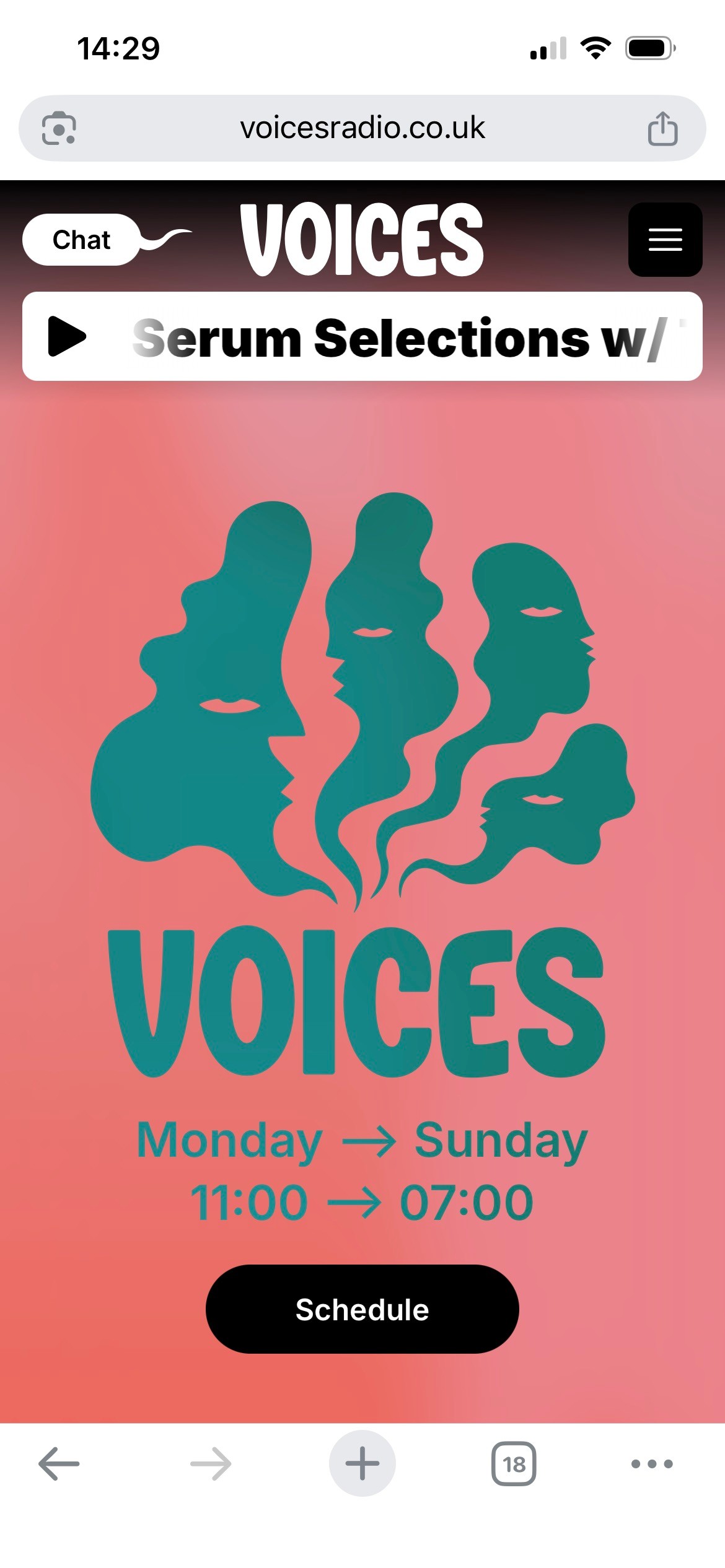
️Before: Voices mobile website Home
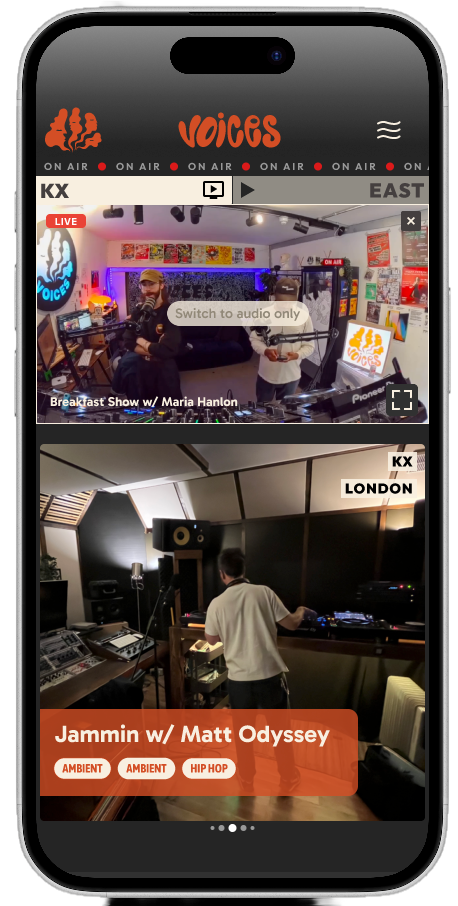
After: Voices mobile website
01
—
SECTION
Context — why this project, why now
Voices Radio is an independent online station with a tight community of hosts and listeners. The product I inherited was a static marketing site bolted onto a third-party player. Three things forced a rethink at once:

A second channel and second studio opening in Hackney Wick, with its own identity to maintain alongside the original.
A mobile app launching in the next couple of months, with no companion design.
A platform migration from Airtime to RadioCult, opening up new functionality the old site couldn't expose.
The brief from the founders was a website redesign. My job was to make sure the redesign actually solved the right problem — not just refreshed the surface.
Voices Radio is growing and their website no longer matches their needs. An upcoming mobile app launch and a second radio channel/location with distinct identity will start a new era. A website redesign is needed in order to represent these changes while maintaining a brand voice and a coherent proposition for main user groups.
02
—
SECTION
Discovery & research
Approach
I planned the discovery phase to triangulate between three sources:
User interviews with three recruited groups — A: existing Voices community, B: net-radio listeners outside the community, C: B2B (later deprioritised). Recruitment via the Voices community chat, founder posts, and personal invites.
Competitive analysis across 11 stations covering direct competitors (NTS, Worldwide FM, Noods, Kiosk, IDA, Radio Panini, Bloop, Crop Manchester, Netil, Do! You! Radio, HÖR) and indirect (Spotify, YouTube).
Feature inventory — a comparison matrix of features each station offers, and which they don't.
What I was trying to learn
Why do listeners come to net radio at all when Spotify exists?
What pulls them to Voices specifically vs other London stations?
Which features feel essential, which are friction, and which are missing entirely?
Key research insights
After affinity-mapping the interviews, four insights kept resurfacing:
Listen-back is the dominant mode, not live. Most listeners can't catch shows live; they come back in the evening. The current site treats listen-back as a secondary archive.
Hosts are the unit of loyalty. People follow DJs, not channels. They want to know when their host is on, listen back to that host, and discover other shows in that orbit.
Discovery is broken. No browse-by-genre, no host pages, no surfacing of what's currently playing. The chat is scattered and rarely read by hosts on air.
Community is the real differentiator vs Spotify. Listeners came to Voices for belonging, not utility. The site doesn't communicate that — Spotify wins on UX, but loses on meaning.
Competitive analysis — what I learned
NTS sets the benchmark for feature breadth: live notifications, schedule of followed hosts, picked-for-you recommendations, integrated chat (read-only, redirects to Discord). Worldwide FM is essentially "NTS Lite" — same shape, fewer features. Most other stations have surprisingly thin apps, which reads as an opportunity for Voices rather than a problem.
A few specific patterns I noted:
NTS shows monthly cadence labels and "next on air" times for special shows — small, high-value detail.
HÖR makes track IDs a paid subscriber perk — interesting monetisation lever.
Worldwide FM's player is non-sticky and cuts when you navigate away. Bad — and an obvious thing for Voices to get right.
Noods has host landing pages but doesn't link to them from show pages, because there's no account/follow feature to anchor them. Feature interdependencies matter.
03
—
SECTION
Synthesis — turning research into direction
Persona — Dora "the Explorer"
I built one primary persona to keep the team aligned — Dora, 35, designer, London, aspiring DJ. Her behaviour is representative of the dominant pattern across interviews: Spotify is her guilty utility; NTS is her primary net radio. She follows hosts, discovers via genre, and comes back to listen back in the evening. She comes to Voices for community, friendliness, versatility, and the ability to watch friends' shows on video stream.
Jobs To Be Done
I structured JTBD across functional, emotional and social dimensions to make sure the redesign wasn't only about features:
Functional — Step out of Spotify's algorithmic bubble. Curate music by real people. Discover across broad genre-spheres.
Emotional (personal) — A sense of belonging. Discover artists you feel a connection to. Learn the personalities behind the shows.
Emotional (social) — Feel encouraged and safe to get involved. Discover events for like-minded people. Understand what music the community appreciates.
Problem statement
I am a Voices Radio listener. I'm trying to find artists that resonate with me. But it's difficult for me to connect to them, because there isn't any information on the site, which makes me feel disconnected from the radio.
This single statement reframed the whole project. The redesign isn't "a new website" — it's a system that makes the connection between listener, host, show, and community legible.
04
—
SECTION
Strategy & IA
From current → prospective site map
The existing site's IA flattened everything into a marketing page with a player bolted on. The schedule lived in one place, hosts didn't have homes, and the second channel had nowhere to live. The new IA splits surfaces by intent:
Listen now / schedule — live state across channels 1 + 2, plus schedule navigation.
Discovery — browse by host, show, and genre. Search across all three.
Host & Show pages — first-class destinations, not nested archive items.
About / Visit Us / Work With Us — separates the editorial brand story from practical calls.
Account / Favourites — anchored later but designed for from day one.
User flows I prioritised
From the JTBD I picked five flows as the redesign's success criteria. If these feel effortless, the redesign works:
Find a host and listen back to their latest show.
Find a relevant show by genre, topic, or artist name.
Discover shows that played a track I love.
Save a show for later listening.
Be notified when my favourite host goes on air.
05
—
SECTION
Design decisions
The decisions where the why matters more than the what — these are the moments hiring managers can probe.
01 — Live show as the centre of gravity
The Live Now card is the primary object on the Radio tab and centres on first load. When the user scrolls past it, a sticky mini-player slides in so play/pause is always one tap away.
Why: Worldwide FM's non-sticky player was the most-cited frustration in the competitive analysis. If listeners come for live + listen-back, the player has to behave like the OS's now-playing UI — present, persistent, never an accidental cut-off.
02 — Schedule with day navigation in the header
Yesterday / Today / Tomorrow chevrons live in a floating chip. The schedule is the page's spine; on day change, the mini-player appears so live audio doesn't get orphaned.
Why: Listen-back is the dominant mode (research insight #1). The fastest path to "a show I missed yesterday" is one tap from the live view, not a separate archive section.
03 — Hosts as first-class pages
Each host has a real page with bio, tags (genre, role), Subscribe / Share actions, and a chronological list of their shows. Subscribe is the anchor for the future Favourites + notifications system.
Why: Hosts are the unit of loyalty (research insight #2). Noods proves the cost of not doing this — host pages exist but go nowhere because there's no account scaffolding underneath. I designed Host pages and Accounts together, even though Accounts ships later, so the IA doesn't need to break later.
04 — Discovery (in progress)
The discovery surface should let users find a show by genre, by topic, by artist who hosted, or by track played. Wireframing in progress — pattern choice (faceted nav vs progressive search) to be decided.
05 — Two channels, one identity (in progress)
The Hackney Wick channel needs distinct identity without fragmenting the brand. Decision pending — current direction is a shared design system with channel-level accent colours and lockups, surfaced contextually.
06
—
SECTION
The work
Note: This project is in active design. Below are the screens completed so far. The hi-fi prototype, design system, and outcome metrics will be added as they land.
Mobile app — Radio / Live
Today's view with the live show card, schedule of the day, day-switcher in the header. Scrolled state with sticky mini-player. Yesterday / Tomorrow views with the same affordances. Expanded scroll showing past + upcoming shows in a single navigable column.
MOBILE APP — RADIO / LIVE
Host page
Host imagery, name, tags (genre, role). Subscribe + Share as primary actions. About + chronological show list with show artwork and metadata.
HOST PAGE
In progress
Discovery, Show LP, Web home, About scroll — currently wireframing.
07
—
SECTION
Reflections
This was a project I loved to work on as a music enthusiast and online radio consumer. It was clear that some of the incumbent stations had discovered and set standards to how listeners interact with radios. I didn’t set out to reinvent the wheel, rather, I listened to the users needs and brought Voices Radio website to a competitive standard.
I consider this new version of the website a foundation for further development and fine tuning. One thing I quickly encountered was the sheer number of important details that had to be designed on every page for a coherent and reactive experience. These details are difficult to plan for and the design process itself reveals them as you begin sketching and testing.
08
—
SECTION
Outcomes
Pending launch. Plan to capture:
Adoption — increase in usage, % live vs listen-back sessions, video vs audio rates.
Engagement — follows per host, average session length, chat participation.
Qualitative — founder + community feedback on whether the redesign feels like Voices.
MORE WORK
More case studies in preparation.
Additional case studies are being written up. Get in touch in the meantime.
Get in touch
→
CAPE FUTURA
Independent UX & business design studio. London, working anywhere.
© 2026 Cape Futura — capefutura.co.uk
Made in Figma
CASE STUDY 01 — Product design — discovery, IA and responsive UX
Voices Radio.
From a static homepage to a community-first listening experience.
Role
Lead UX Designer (research, strategy, IA, interaction, visual)
Client
Voices Radio: independent online radio station, London
Scope
Website redesign (Home + Discovery) & Design System
Timeline
Six weeks
Status
In build
Tools
Figma, user interviews, Claude, ChatGPT
TL;DR
Summary
Voices Radio is growing fast - a second studio in Hackney Wick, a mobile app on the way, and a platform migration to RadioCult. Their existing site couldn't carry that weight: it didn't reflect the community, made it hard to find shows or hosts, and treated listening as an afterthought.
I led the redesign end-to-end. Through 10+ user interviews, competitive analysis across 11 stations, and synthesis into personas, JTBD and a problem statement, I reframed the brief from "redesign the site" to "design a listening experience that lets people belong to a scene, not just press play."
The result is a new site IA, a mobile app, and a design system with the host/show as the atomic unit - surfacing live programming, listen-back, host identity and chat in one coherent flow.
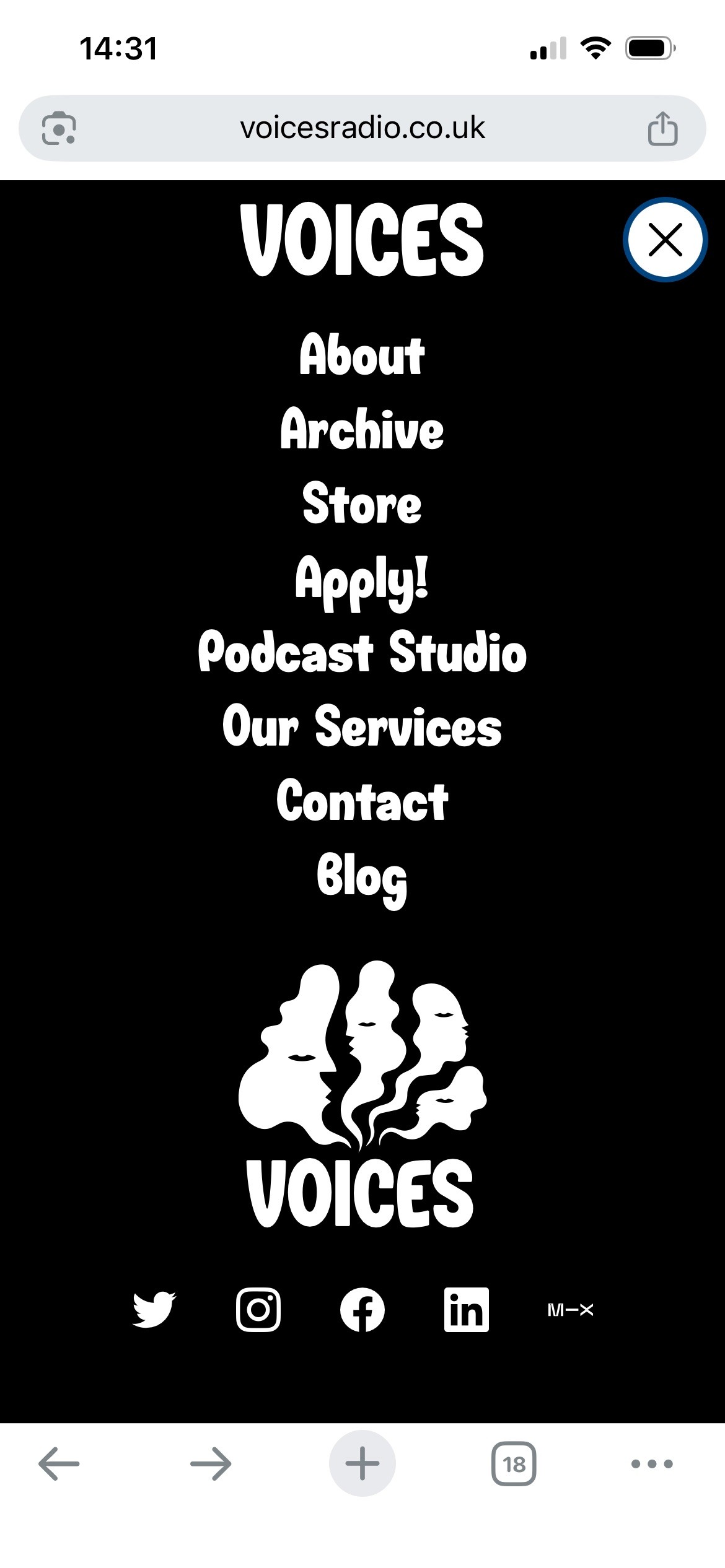
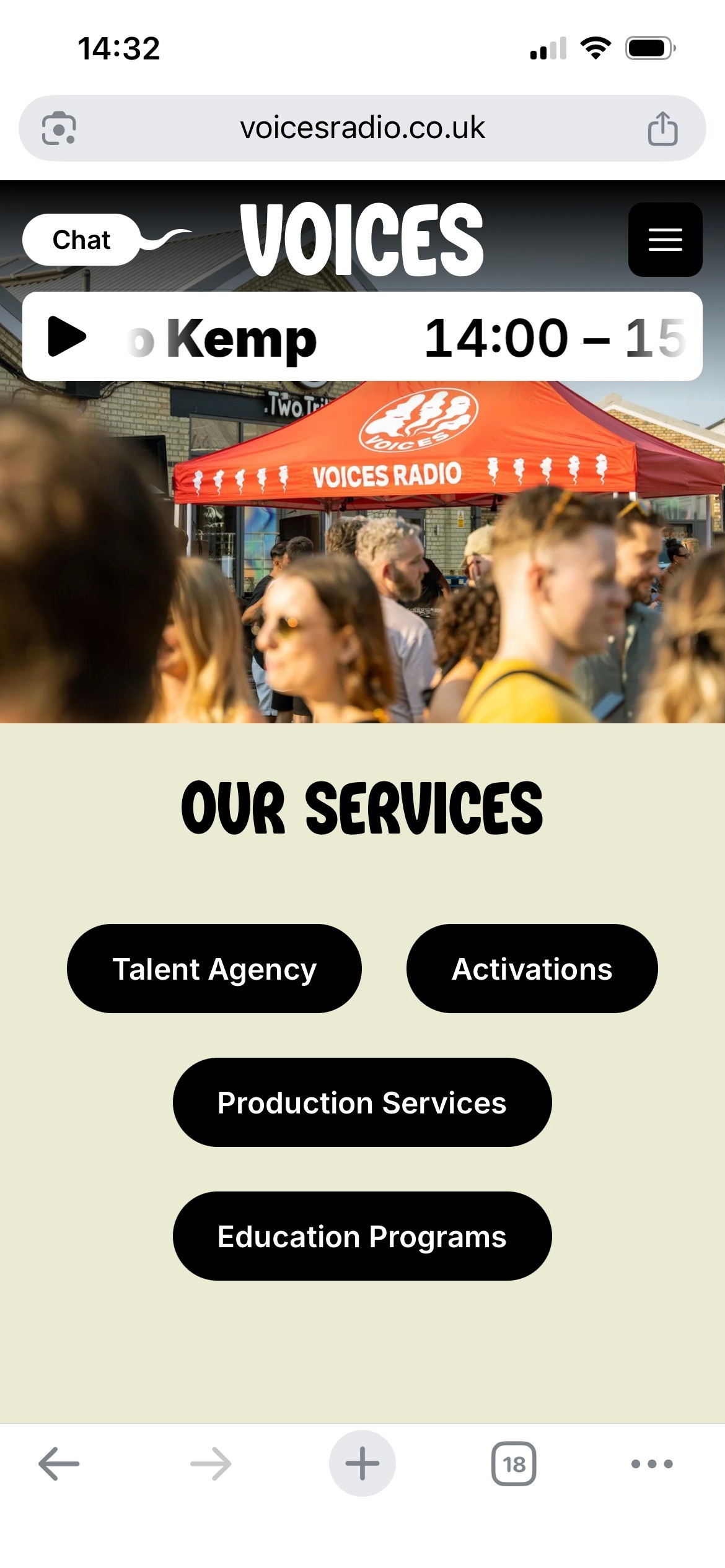
️Before: Voices mobile website Home x 2 / Menu / Our Services ↴
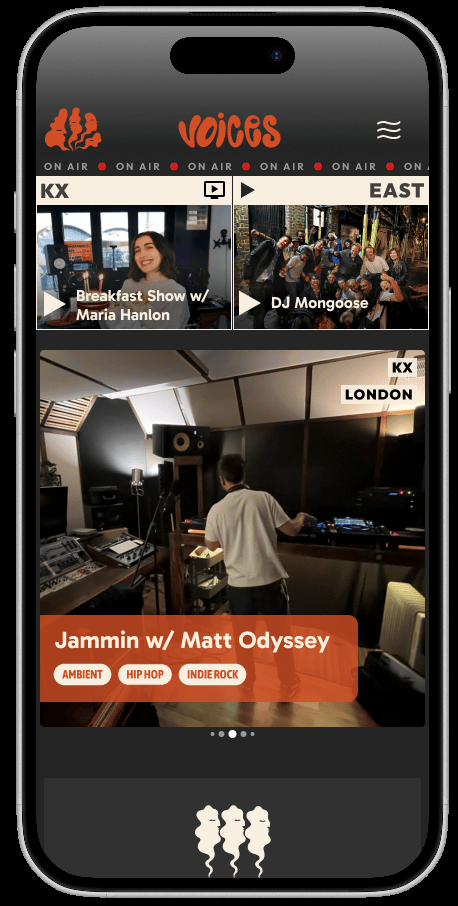
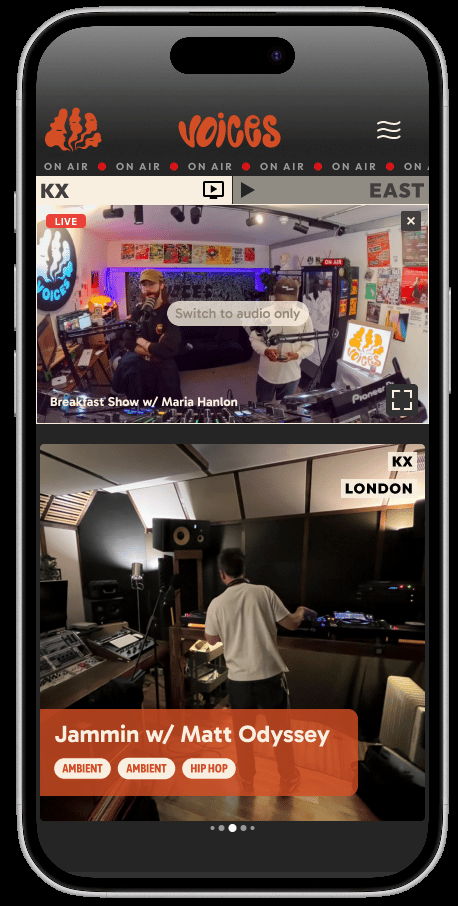
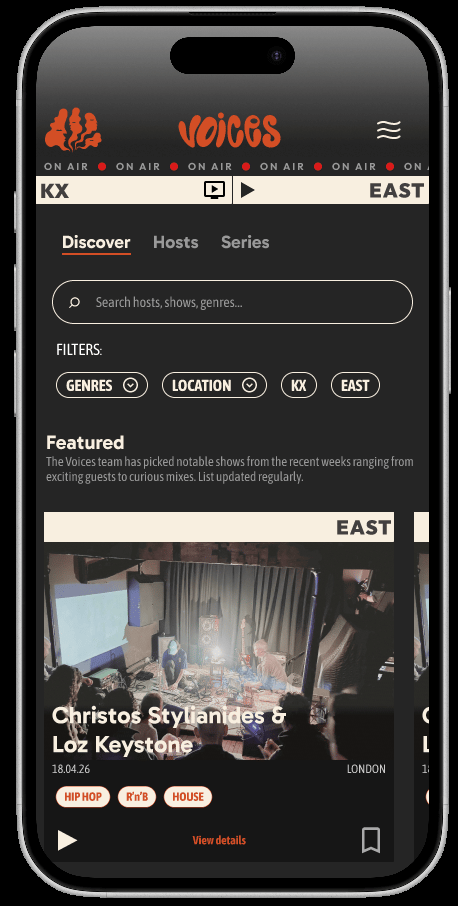
After: Voices mobile website Home x 2 / Discover ↴
01
—
SECTION
Context — why this project, why now
Voices Radio is an independent online station with a tight community of hosts and listeners. The product I inherited was a static marketing site bolted onto a third-party player. Three things forced a rethink at once:
A second channel and second studio opening in Hackney Wick, with its own identity to maintain alongside the original.
A mobile app launching in the next couple of months, with no companion design.
A platform migration from Airtime to RadioCult, opening up new functionality the old site couldn't expose.
The brief from the founders was a website redesign. My job was to make sure the redesign actually solved the right problem — not just refreshed the surface.
Voices Radio is growing and their website no longer matches their needs. An upcoming mobile app launch and a second radio channel/location with distinct identity will start a new era. A website redesign is needed in order to represent these changes while maintaining a brand voice and a coherent proposition for main user groups.
02
—
SECTION
Discovery & research
Approach
I planned the discovery phase to triangulate between three sources:
User interviews with three recruited groups - A: existing Voices community, B: net-radio listeners outside the community, C: B2B (later deprioritised). Recruitment via the Voices community chat, founder posts, and personal invites.
Competitive analysis across 11 stations covering direct competitors (NTS, Worldwide FM, Noods, Kiosk, IDA, Radio Panini, Bloop, Crop Manchester, Netil, Do! You! Radio, HÖR) and indirect (Spotify, YouTube).
Feature inventory - a comparison matrix of features each station offers, and which they don't.
What I was trying to learn
Why do listeners come to net radio at all when Spotify exists?
What pulls them to Voices specifically vs other London stations?
Which features feel essential, which are friction, and which are missing entirely?
Key research insights
After affinity-mapping the interviews, four insights kept resurfacing:
Listen-back is the dominant mode, not live. Most listeners can't catch shows live; they come back in the evening. The current site treats listen-back as a secondary archive.
Hosts are the unit of loyalty. People follow DJs, not channels. They want to know when their host is on, listen back to that host, and discover other shows in that orbit.
Discovery is broken. No browse-by-genre, no host pages, no surfacing of what's currently playing. The chat is scattered and rarely read by hosts on air.
Community is the real differentiator vs Spotify. Listeners came to Voices for belonging, not utility. The site doesn't communicate that — Spotify wins on UX, but loses on meaning.
Competitive analysis — what I learned
NTS sets the benchmark for feature breadth: live notifications, schedule of followed hosts, picked-for-you recommendations, integrated chat (read-only, redirects to Discord). Worldwide FM is essentially "NTS Lite" - same shape, fewer features. Most other stations have surprisingly thin apps, which reads as an opportunity for Voices rather than a problem.
A few specific patterns I noted:
NTS shows monthly cadence labels and "next on air" times for special shows — small, high-value detail.
HÖR makes track IDs a paid subscriber perk — interesting monetisation lever.
Worldwide FM's player is non-sticky and cuts when you navigate away. Bad — and an obvious thing for Voices to get right.
Noods has host landing pages but doesn't link to them from show pages, because there's no account/follow feature to anchor them. Feature interdependencies matter.
03
—
SECTION
Synthesis — turning research into direction
Persona — Dora "the Explorer"
I built one primary persona to keep the team aligned - Dora, 35, designer, London, aspiring DJ. Her behaviour is representative of the dominant pattern across interviews: Spotify is her guilty utility; NTS is her primary net radio. She follows hosts, discovers via genre, and comes back to listen back in the evening. She comes to Voices for community, friendliness, versatility, and the ability to watch friends' shows on video stream.
Jobs To Be Done
I structured JTBD across functional, emotional and social dimensions to make sure the redesign wasn't only about features:
Functional — Step out of Spotify's algorithmic bubble. Curate music by real people. Discover across broad genre-spheres.
Emotional (personal) — A sense of belonging. Discover artists you feel a connection to. Learn the personalities behind the shows.
Emotional (social) — Feel encouraged and safe to get involved. Discover events for like-minded people. Understand what music the community appreciates.
Problem statement
I am a Voices Radio listener. I'm trying to find artists that resonate with me. But it's difficult for me to connect to them, because there isn't any information on the site, which makes me feel disconnected from the radio.
This single statement reframed the whole project. The redesign isn't "a new website" — it's a system that makes the connection between listener, host, show, and community legible.
04
—
SECTION
Strategy & IA
From current → prospective site map
The existing site's IA flattened everything into a marketing page with a player bolted on. The schedule lived in one place, hosts didn't have homes, and the second channel had nowhere to live. The new IA splits surfaces by intent:
Listen now / schedule — live state across channels 1 + 2, plus schedule navigation.
Discovery — browse by host, show, and genre. Search across all three.
Host & Show pages — first-class destinations, not nested archive items.
About / Visit Us / Work With Us — separates the editorial brand story from practical calls.
Account / Favourites — anchored later but designed for from day one.
User flows I prioritised
From the JTBD I picked five flows as the redesign's success criteria. If these feel effortless, the redesign works:
Find a host and listen back to their latest show.
Find a relevant show by genre, topic, or artist name.
Discover shows that played a track I love.
Save a show for later listening.
Be notified when my favourite host goes on air.
05
—
SECTION
Design decisions
01 — Live show as the centre of gravity
The Live Now card is the primary object on the Radio tab and centres on first load. When the user scrolls past it, a sticky mini-player slides in so play/pause is always one tap away.
Why: Worldwide FM's non-sticky player was the most-cited frustration in the competitive analysis. If listeners come for live + listen-back, the player has to behave like the OS's now-playing UI — present, persistent, never an accidental cut-off.
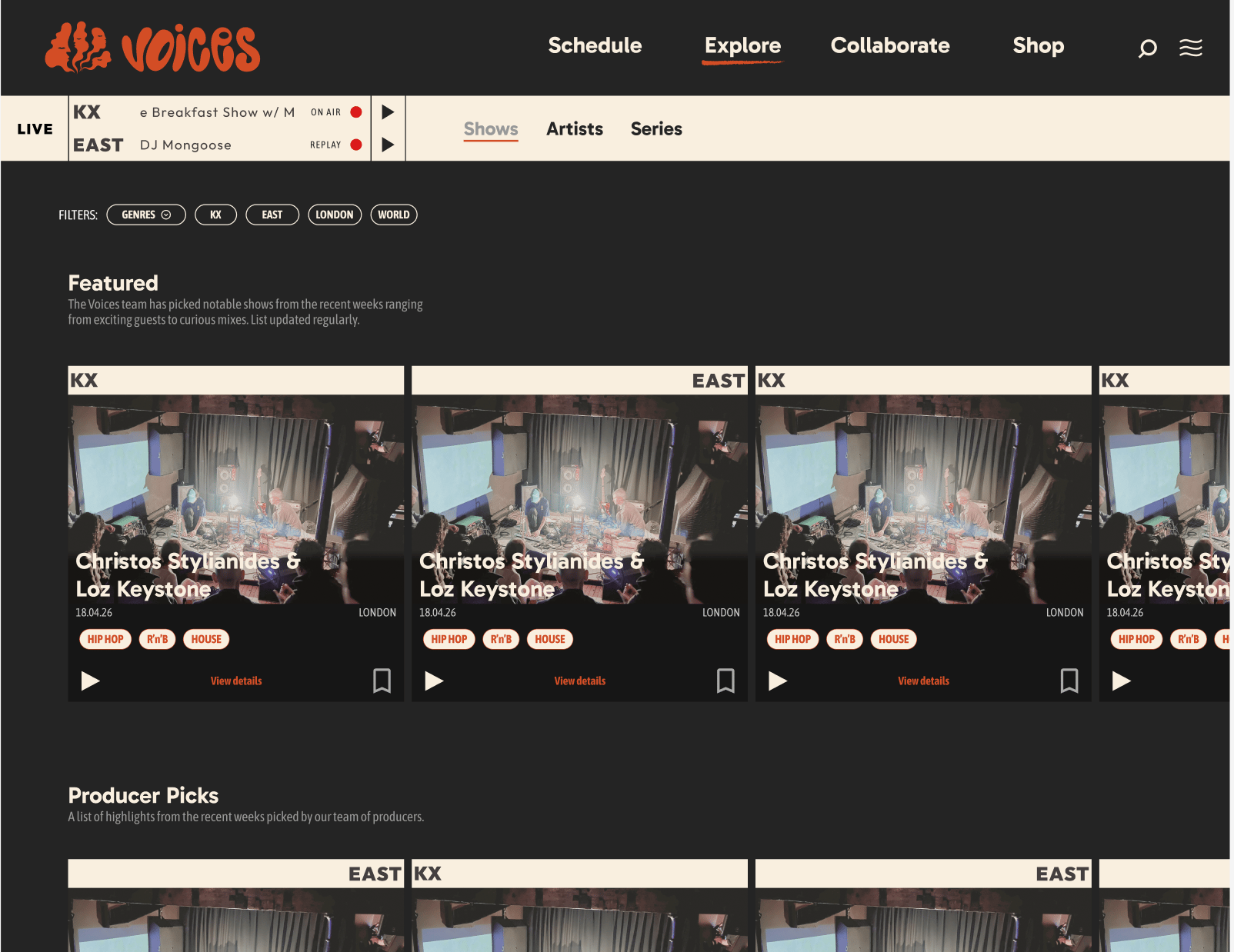
02 — Discovery
The discovery surface which we titled “Explore” should let users find shows by genre, by topic, or by artist who hosted. I minimised the live stations into a secondary bar on top to free real estate for browsing while maintaining a tether to the live broadcast.
Explore landing page includes curated (manually or automatically) category carousels while also offering filters. Universal search remains in the header navigation.
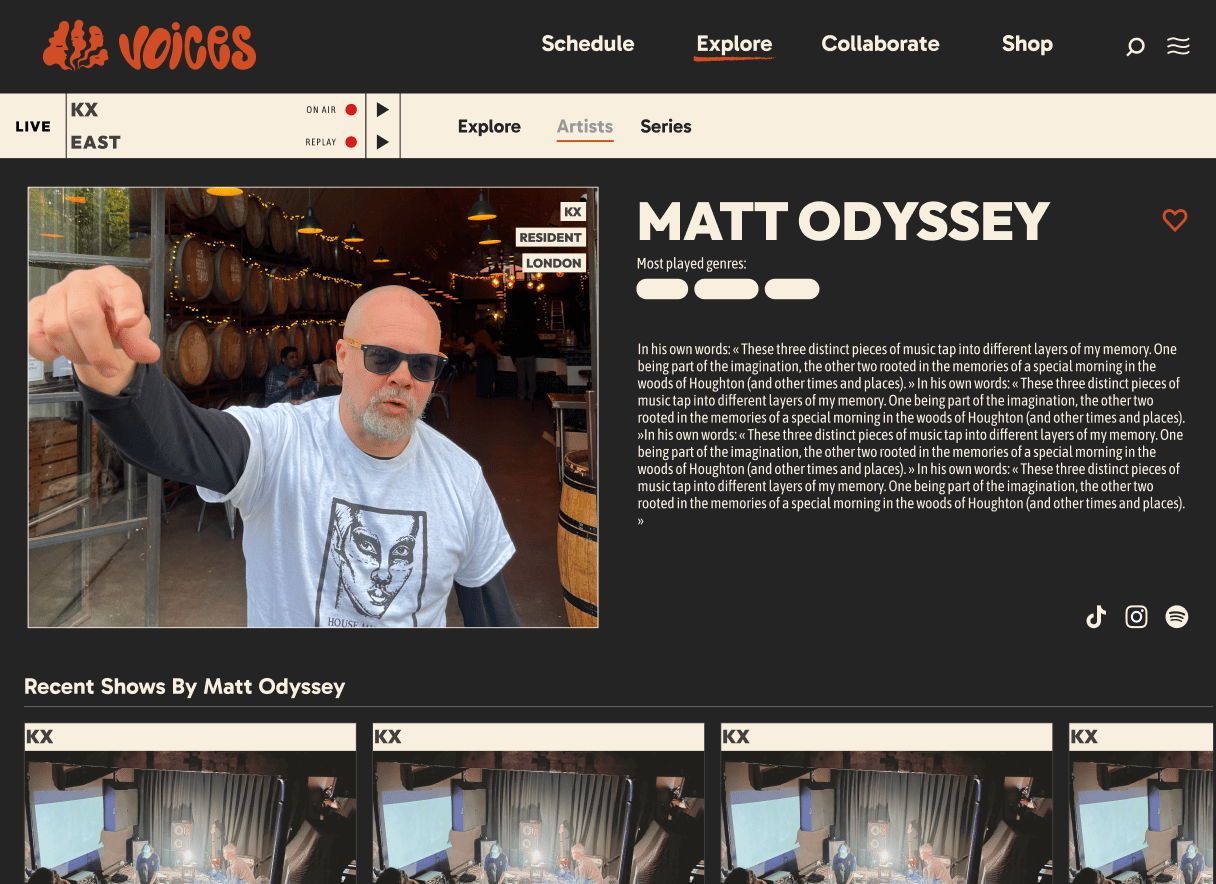
03 — Host page
Host imagery, name, tags (genre, role). Subscribe + Share as primary actions. About + chronological show list with show artwork and metadata.
06
—
SECTION
Reflections
This was a project I loved to work on as a music enthusiast and online radio consumer. It was clear that some of the incumbent stations had discovered and set standards to how listeners interact with radios. I didn’t set out to reinvent the wheel, rather, I listened to the users needs and brought Voices Radio website to a competitive standard.
I consider this new version of the website a foundation for further development and fine tuning. One thing I quickly encountered was the sheer number of important details that had to be designed on every page for a coherent and reactive experience. These details are difficult to plan for and the design process itself reveals them as you begin sketching and testing.
07
—
SECTION
Outcomes
Pending launch. Plan to capture:
Adoption — increase in usage, % live vs listen-back sessions, video vs audio rates.
Engagement — follows per host, average session length, chat participation.
Qualitative — founder + community feedback on whether the redesign feels like Voices.
MORE WORK
More case studies in preparation.
Additional case studies are being written up. Get in touch in the meantime.
Get in touch
→

CASE STUDY 01 — Product design — discovery, IA and responsive UX
Voices Radio.
From a static homepage to a community-first listening experience.
Role
Lead UX Designer (research, strategy, IA, interaction, visual)
Client
Voices Radio: independent online radio station, London
Scope
Website redesign (Home + Discovery) & Design System
Timeline
Six weeks
Status
In build
Tools
Figma, user interviews, Claude, ChatGPT
TL;DR
Summary
Voices Radio is growing fast - a second studio in Hackney Wick, a mobile app on the way, and a platform migration to RadioCult. Their existing site couldn't carry that weight: it didn't reflect the community, made it hard to find shows or hosts, and treated listening as an afterthought.
I led the redesign end-to-end. Through 10+ user interviews, competitive analysis across 11 stations, and synthesis into personas, JTBD and a problem statement, I reframed the brief from "redesign the site" to "design a listening experience that lets people belong to a scene, not just press play."
The result is a new site IA, a mobile app, and a design system with the host/show as the atomic unit - surfacing live programming, listen-back, host identity and chat in one coherent flow.
CONTENTS
01 Context — why this project, why now
02 Discovery & research
03 Synthesis — turning research into direction
04 Strategy & IA
05 Design decisions
06 The work
07 Reflections
08 Outcomes
️Before: Voices mobile website Home x 2 / Menu / Our Services ↴
After: Voices mobile website Home x 2 / Discover ↴
01
—
SECTION
Context — why this project, why now
Voices Radio is an independent online station with a large community of hosts and listeners. The product I inherited was a static marketing site bolted onto a third-party player. Three things forced a rethink at once:
A second channel and second studio opening in Hackney Wick, with its own identity to maintain alongside the original.
A mobile app launching in the next couple of months, with no companion design.
A platform migration from Airtime to RadioCult, opening up new functionality the old site couldn't expose.
The brief from the founders was a website redesign. My job was to make sure the redesign actually solved the right problem — not just refreshed the surface.
Voices Radio is growing and their website no longer matches their needs. An upcoming mobile app launch and a second radio channel/location with distinct identity will start a new era. A website redesign is needed in order to represent these changes while maintaining a brand voice and a coherent proposition for main user groups.
02
—
SECTION
Discovery & research
Approach
I planned the discovery phase to triangulate between three sources:
User interviews with three recruited groups — A: existing Voices community, B: net-radio listeners outside the community, C: B2B (later deprioritised). Recruitment via the Voices community chat, founder posts, and personal invites.
Competitive analysis across 11 stations covering direct competitors (NTS, Worldwide FM, Noods, Kiosk, IDA, Radio Panini, Bloop, Crop Manchester, Netil, Do! You! Radio, HÖR) and indirect (Spotify, YouTube).
Feature inventory — a comparison matrix of features each station offers, and which they don't.
What I was trying to learn
Why do listeners come to net radio at all when Spotify exists?
What pulls them to Voices specifically vs other London stations?
Which features feel essential, which are friction, and which are missing entirely?
Key research insights
After affinity-mapping the interviews, four insights kept resurfacing:
Listen-back is the dominant mode, not live. Most listeners can't catch shows live; they come back in the evening. The current site treats listen-back as a secondary archive.
Hosts are the unit of loyalty. People follow DJs, not channels. They want to know when their host is on, listen back to that host, and discover other shows in that orbit.
Discovery is broken. No browse-by-genre, no host pages, no surfacing of what's currently playing. The chat is scattered and rarely read by hosts on air.
Community is the real differentiator vs Spotify. Listeners came to Voices for belonging, not utility. The site doesn't communicate that — Spotify wins on UX, but loses on meaning.
Competitive analysis — what I learned
NTS sets the benchmark for feature breadth: live notifications, schedule of followed hosts, picked-for-you recommendations, integrated chat (read-only, redirects to Discord). Worldwide FM is essentially "NTS Lite" — same shape, fewer features. Most other stations have surprisingly thin apps, which reads as an opportunity for Voices rather than a problem.
A few specific patterns I noted:
NTS shows monthly cadence labels and "next on air" times for special shows — small, high-value detail.
HÖR makes track IDs a paid subscriber perk — interesting monetisation lever.
Worldwide FM's player is non-sticky and cuts when you navigate away. Bad — and an obvious thing for Voices to get right.
Noods has host landing pages but doesn't link to them from show pages, because there's no account/follow feature to anchor them. Feature interdependencies matter.
03
—
SECTION
Synthesis — turning research into direction
Persona — Dora "the Explorer"
I built one primary persona to keep the team aligned:
- Dora, 35, designer
- London
- Aspiring DJ
Her behaviour is representative of the dominant pattern across interviews: Spotify is her guilty utility; NTS is her primary net radio. She follows hosts, discovers via genre, and comes back to listen back in the evening. She comes to Voices for community, friendliness, versatility, and the ability to watch friends' shows on video stream.
Jobs To Be Done
I structured JTBD across functional, emotional and social dimensions to make sure the redesign wasn't only about features:
Functional — Step out of Spotify's algorithmic bubble. Curate music by real people. Discover across broad genre-spheres.
Emotional (personal) — A sense of belonging. Discover artists you feel a connection to. Learn the personalities behind the shows.
Emotional (social) — Feel encouraged and safe to get involved. Discover events for like-minded people. Understand what music the community appreciates.
Problem statement
I am a Voices Radio listener. I'm trying to find artists that resonate with me. But it's difficult for me to connect to them, because there isn't any information on the site, which makes me feel disconnected from the radio.
This single statement reframed the whole project. The redesign isn't "a new website" — it's a system that makes the connection between listener, host, show, and community legible.
04
—
SECTION
Strategy & IA
From current → prospective site map
The existing site's IA flattened everything into a marketing page with a player bolted on. The schedule lived in one place, hosts didn't have homes, and the second channel had nowhere to live. The new IA splits surfaces by intent:
Listen now / schedule — live state across channels 1 + 2, plus schedule navigation.
Discovery — browse by host, show, and genre. Search across all three.
Host & Show pages — first-class destinations, not nested archive items.
About / Visit Us / Work With Us — separates the editorial brand story from practical calls.
Account / Favourites — anchored later but designed for from day one.
User flows I prioritised
From the JTBD I picked five flows as the redesign's success criteria. If these feel effortless, the redesign works:
Find a host and listen back to their latest show.
Find a relevant show by genre, topic, or artist name.
Discover shows that played a track I love.
Save a show for later listening.
Be notified when my favourite host goes on air.
05
—
SECTION
Design decisions
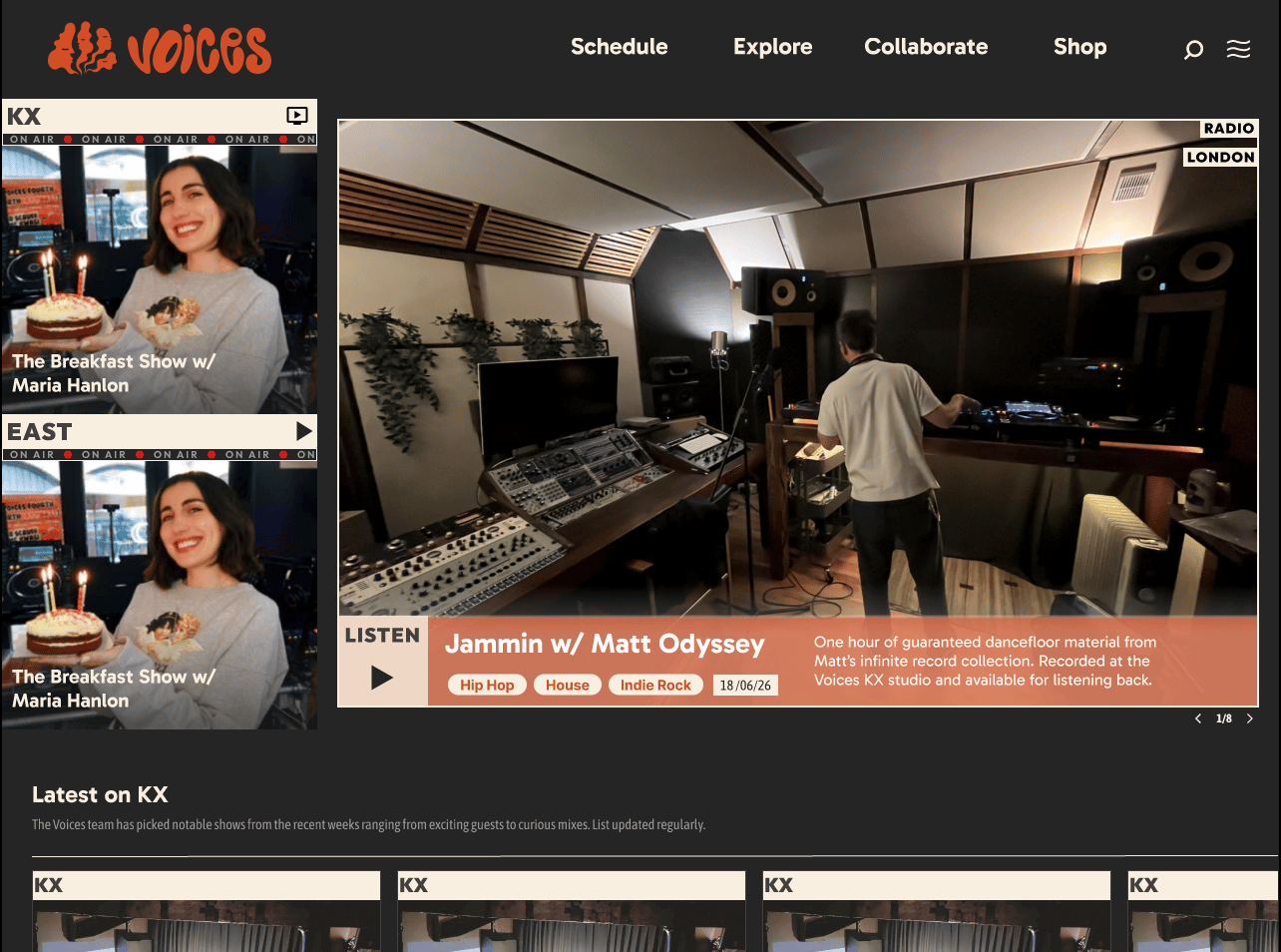
01 — Live channels & featured recordings as the big 3
LIVE broadcasting is the essence of radio, and with live video stream as Voices USP I wanted to feature the live channels more prominently compared to competitors who often only surface them as small navigation bar feature.
Feature carousel highlighting the most notable recordings, events and news from the recent weeks serves as a strong engagement tool. As user interviews taught us, discovery and “listening back” are a huge driver for engagement.
02 — Discovery
The discovery surface which we titled “Explore” should let users find shows by genre, by topic, or by artist who hosted. I minimised the live stations into a secondary bar on top to free real estate for browsing while maintaining a tether to the live broadcast.
Explore landing page includes curated (manually or automatically) category carousels while also offering filters. Universal search remains in the header navigation.
Note: This project is in active build at the time of writing. Below are the screens completed in Figma.
03 — Host page
Host imagery, name, tags (genre, role). Subscribe + Share as primary actions. About + chronological show list with show artwork and metadata.
06
—
SECTION
Reflections
This was a project I loved to work on as a music enthusiast and online radio consumer. It was clear that some of the incumbent stations had discovered and set standards to how listeners interact with radios. I didn’t set out to reinvent the wheel, rather, I listened to the users needs and brought Voices Radio website to a competitive standard.
I consider this new version of the website a foundation for further development and fine tuning. One thing I quickly encountered was the sheer number of important details that had to be designed on every page for a coherent and reactive experience. These details are difficult to plan for and the design process itself reveals them as you begin sketching and testing.
07
—
SECTION
Outcomes
Pending launch. Plan to capture:
Adoption — increase in usage, % live vs listen-back sessions, video vs audio rates.
Engagement — follows per host, average session length, chat participation.
Qualitative — founder + community feedback on whether the redesign feels like Voices.
MORE WORK
More case studies in preparation.
Additional case studies are being written up. Get in touch in the meantime.